Blog Ecobraz Eigre
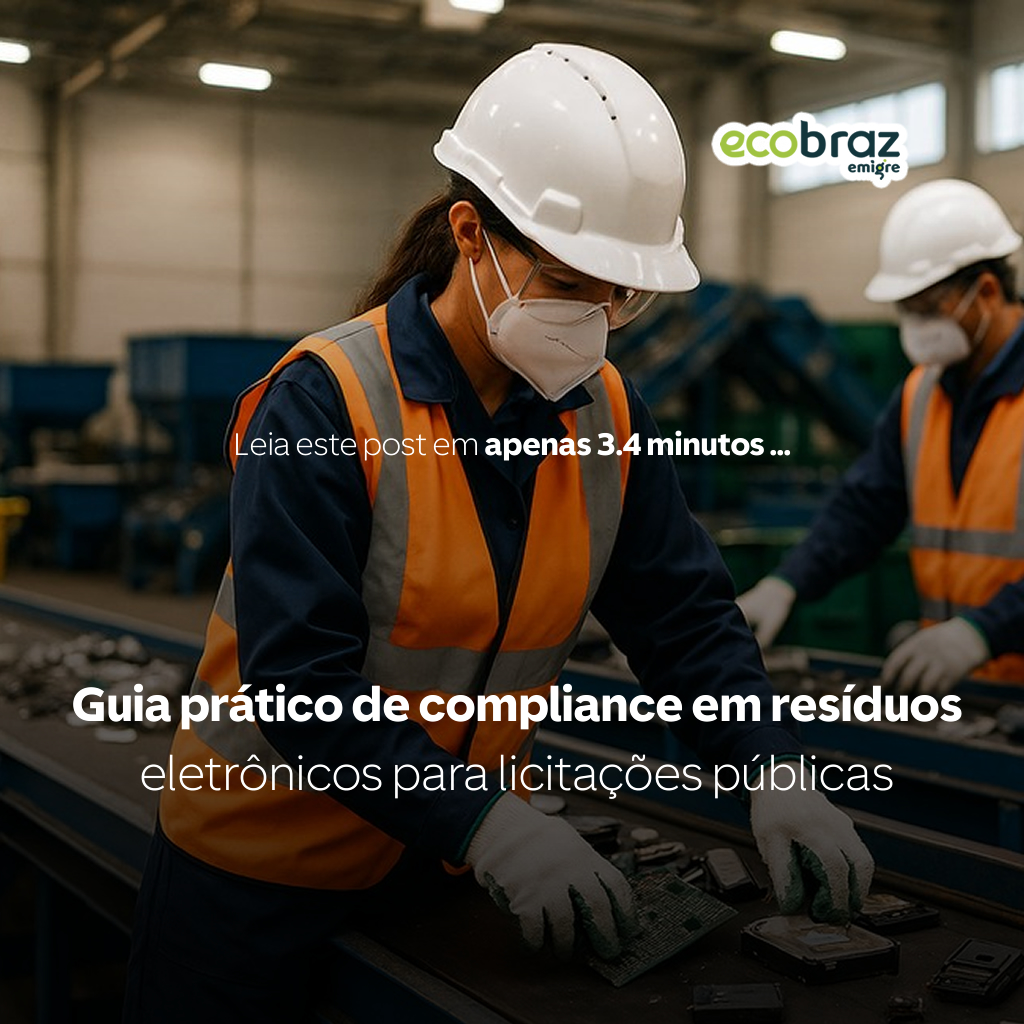
Practical guide to e-waste compliance for public procurement
Publication date: 2025-10-22
Practical guide to e-waste compliance for public procurement
Description: Companies taking part in public procurement must meet increasingly strict requirements in sustainability and electronic waste disposal. This guide brings together legislation, best practices, and solutions offered by the Ecobraz Emigre NGO to ensure compliance and competitiveness.
Why environmental compliance is decisive in public procurement
In recent years, public agencies have begun requiring environmental compliance proof in procurement processes. This means companies must go beyond competitive pricing and demonstrate solid practices in reverse logistics, e-waste recycling, and hazardous waste management.
According to the World Bank, sustainable public procurement moves trillions of dollars globally, serving as an incentive mechanism for responsible corporate practices.
What does Brazilian legislation say?
In Brazil, three regulatory pillars directly impact procurement related to electronic waste:
- Law 12.305/2010 – National Solid Waste Policy (PNRS): establishes shared responsibility for product life cycles.
- Law 8.666/1993 and Law 14.133/2021: regulate procurement and allow sustainability criteria to be used in evaluating bids.
- CONAMA Resolutions: set technical rules for safe disposal of hazardous waste, including electronics.
Common challenges for companies in procurement
Among the main obstacles faced by companies seeking public contracts are:
- Difficulty proving the correct disposal of obsolete electronics;
- Lack of technical reports and transportation manifests;
- Risk of fines for non-compliance with environmental law;
- Poor integration with ESG and corporate compliance policies.
How Ecobraz strengthens competitiveness
The Ecobraz Emigre NGO provides infrastructure and full documentation for companies aiming to meet public procurement requirements:
- Nationwide collection: service available in all regions of Brazil;
- Certified recycling process: dismantling, sorting, and final destination of e-waste;
- Technical reports and manifests: official documents to prove compliance;
- ESG reports: detailed environmental metrics to strengthen proposals in bids;
- International compliance: alignment with global practices such as the EU Waste Electrical and Electronic Equipment Directive (WEEE).
Examples of tenders with environmental requirements
In recent years, procurement processes in several Brazilian states and municipalities have included clauses requiring proof of proper electronic waste disposal. This trend is expected to intensify with the growth of the ESG agenda and circular economy practices.
Strategic benefits for companies
Adopting e-waste recycling with Ecobraz generates benefits beyond legal compliance:
- Risk reduction: avoids fines and environmental liabilities;
- Competitive differentiation: stronger proposals in public and private bids;
- Brand value: reinforcement of sustainable image with clients and investors;
- Contribution to the circular economy: reuse of critical raw materials.
References for further reading
This guide was developed based on official and internationally recognized sources, including:
- IBAMA – Brazilian Institute of Environment
- UNEP – United Nations Environment Programme
- European WEEE Directive
- Brazilian Federal Court of Accounts (TCU)
Conclusion
Environmental compliance is no longer a differentiator – it is a mandatory requirement for companies seeking public contracts. By adopting solid e-waste recycling practices, your organization not only complies with legislation but also positions itself as a sustainability leader.
Call to action
Turn compliance into a competitive advantage. Contact the Ecobraz Emigre NGO and discover complete solutions for managing electronic waste in public procurement.
📞 +55 11 4329-2001
✉️ [email protected]
🌐 www.ecobraz.org
ManifestTransparency & Security Manifesto
Evidence and transparency: Our ESG approach is built on traceable documentation, verifiable records and auditable operational criteria. We turn electronic waste management into operational evidence to support governance, traceability and the mitigation of environmental, documentary and corporate risks. Documentary security and compliance: Documented traceability helps reduce regulatory exposure, strengthens documentary defensibility and supports alignment with applicable environmental policies, corporate contracts and governance requirements, including national and international references relevant to supply chains. Operational costing of reverse logistics: Door-to-door collection and responsible processing of electronic waste involve relevant logistics, technical and documentary costs. For this reason, Ecobraz structures transparent operational costing models linked to reverse logistics execution, with no promise of financial return, investment or asset appreciation. Governance: Operational execution is guided by compliance, traceability and verifiable documentation criteria. The priority is to strengthen the client’s corporate evidence, reduce documentary gaps and support safer, more responsible and defensible disposal decisions.

Deixe um comentário
O seu endereço de e-mail não será publicado. Campos obrigatórios são marcados com *